
Exploring the Czech Republic with a dog: entry, transport and travel planning
Travelling to the Czech Republic with your dog is easiest when your entry documents, transport, places to visit and accommodation all fit together. A microchip, rabies vaccination and pet passport are just as important as the rail and Prague public transport rules, as well as access requirements in natural areas.
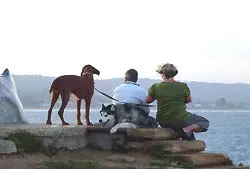 Für die Einreise mit Hund nach Tschechien ist neben dem EU Heimtierausweis vor allem eine eindeutige Kennzeichnung durch Microchip Voraussetzung.
Photo: M. Lenk
Key facts about holidays with a dog in the Czech Republic
- For a non-commercial trip from an EU country, your dog needs a microchip, a valid rabies vaccination and an EU pet passport.
- The first rabies vaccination can be given no earlier than 12 weeks of age and becomes valid only 21 days after the primary vaccination course is complete.
- On České dráhy, dogs travelling outside a closed carrier must wear a muzzle and be kept on a short lead, and need a ticket priced according to the distance travelled.
- On Prague’s PID public transport, dogs travel in Prague’s fare zones with a valid PID ticket at no extra charge.
- In Šumava National Park, dogs must remain under constant control; in the first protection zone, hikers must stay on marked trails.
- Whether a dog is allowed in accommodation, restaurants or visitor attractions is up to the individual provider.
Travelling from the EU: microchip, vaccination and pet passport
For a private, non-commercial trip from Germany or another EU country, your dog needs to be clearly identified with a microchip, have a valid rabies vaccination and an EU pet passport. The order matters: the microchip must be implanted or read before the rabies vaccination. At the time of the first vaccination, the dog must be at least 12 weeks old; after completion of the primary vaccination course, the vaccination becomes valid only after a 21-day waiting period. A booster given on time, before the previous vaccination expires, avoids a new gap in validity.
Updated EU rules for non-commercial travel with pets have applied since 22 April 2026. For ordinary travel, a maximum of five dogs, cats or ferrets per vehicle is allowed. If the animal and its owner are not travelling together, written authorisation and a five-day time window apply. The EU requires additional tapeworm treatment only for certain other destinations; the Czech Republic is not on that list. Different documentation requirements apply when travelling from non-EU countries. The EU overview of travelling with pets explains the current requirements and exceptions.
Carry the pet passport with you during your trip and check the microchip number and vaccination date before departure. If your dog is still young, its vaccination has expired, or someone else will be travelling with it, check the requirements with your veterinary practice well in advance. For a holiday that includes a return journey, make sure the documents cover the entire route.
Getting around by car or train
Travelling by car gives you more flexibility when choosing a base, especially if you plan to explore different walking routes from a rural starting point. Plan for breaks, water and enough time for stops along the way. To choose between a city, nature or spa destination, see the overview of regions and travel bases in the Czech Republic. If you want to combine several modes of transport, you’ll find more guidance on getting to and planning a trip in the Czech Republic.
Dogs can travel in second class on almost all České dráhy (ČD) trains. Outside a closed carrier, a dog must wear a muzzle and be kept on a short lead; it also needs a dog ticket priced according to the distance travelled. A small dog can travel free of charge in a closed carrier with a waterproof base, provided the carrier is no larger than 90 × 60 × 40 centimetres. Dogs travelling outside a carrier are not allowed in first class, restaurant and bistro cars, or certain family and quiet-zone cars, among other restrictions. When changing trains, check whether other transport operators are involved: their rules and ticket conditions may differ.
Travelling with a dog on Prague’s public transport
On Prague Integrated Transport (PID), dogs may travel either in a closed carrier with a waterproof base or wearing a secure muzzle and on a short lead. The lead and muzzle rules also apply in metro stations. Since 1 January 2026, dogs have travelled free of charge in Prague fare zones P, 0 and B, provided the person accompanying them has a valid PID ticket. Space for dogs is limited on trams, buses and trolleybuses; tell the driver before boarding that you are travelling with a dog, and be aware that they may refuse to let you travel if there are space or safety concerns. Outside Prague, conditions vary by operator, route and fare zone.
For a day in the city, also check whether your dog is allowed in the indoor venues on your itinerary. Museums, castles, restaurants and event organisers set their own rules; there is no general permission that applies throughout the Czech Republic. Plan an outdoor alternative in case you have to visit without your dog.
A nature holiday: follow the rules for trails and protected areas
A nature holiday is a good fit when the daily distances and terrain suit your dog. In Šumava National Park, pets must remain under the constant control of the person accompanying them. In the first nature protection zone, hikers may use only marked trails; groomed cross-country ski tracks are off-limits to dogs, except assistance dogs. Temporary protection measures may also apply to specific trails. So choose not just a landscape, but specific day-trip destinations where access is permitted on the day of your visit.
The overview of Lipno, Kvilda and Železná Ruda in the Bohemian Forest can help you compare different starting points and landscapes. For more nature destinations, see the overview of Czech nature and landscapes. This does not replace local protected-area rules: leash requirements, trail restrictions, seasonal closures and access to individual facilities vary from one area to another.
Choose a suitable base and accommodation
For a city break, short distances and access to public transport matter; for a nature holiday, consider suitable day-trip distances and access to the trails you plan to use. First decide which places you want to visit, then compare the types of holidays and travel in the Czech Republic. If your destinations are far apart, staying in two places may make more sense than taking long drives every day. Also consider whether your dog is comfortable with frequent changes of location.
Dogs are not automatically welcome at every accommodation. Before booking, get written confirmation that dogs are allowed, whether there are limits on their number, size or weight, and whether extra charges apply. Also ask about rules for rooms, communal areas, gardens and leaving your dog alone. The Czech Republic accommodation guide can help you choose a location and type of accommodation; only the individual property can confirm that your dog is welcome. Also check where you can walk nearby and whether you need to take account of roads, protected areas or private land.
FAQ / Frequently asked questions about holidays with a dog in the Czech Republic
What documents does my dog need to travel from Germany?
For non-commercial travel within the EU, you need an EU pet passport, a readable microchip identification and a valid rabies vaccination. At the time of the first vaccination, your dog must be at least 12 weeks old; a 21-day waiting period applies afterwards. Before departure, check that the microchip number and vaccination status in the passport are correct.
Does my dog have to wear a muzzle on the train?
On ČD trains, a dog travelling outside a closed carrier must wear a muzzle and be kept on a short lead. A dog ticket priced according to the distance travelled is required. A small dog can travel free of charge in a closed carrier with a waterproof base, subject to the published size limits.
Can my dog travel free on the metro or tram in Prague?
Yes. Since 1 January 2026, dogs have travelled free of charge in Prague PID zones P, 0 and B, provided the person accompanying them has a valid PID ticket. Outside a closed carrier, the dog must wear a secure muzzle and be kept on a short lead; travel is also subject to available space.
Can I hike with my dog in Šumava National Park?
Yes, as long as your dog remains under your constant control and you follow the trail rules. In the first nature protection zone, only marked hiking trails may be used. Groomed cross-country ski tracks are off-limits to dogs, except assistance dogs; temporary trail closures may also apply.
Can I automatically book any accommodation with a dog?
No. Before booking, ask the specific property whether dogs are allowed, whether there are any restrictions and whether extra charges apply. Also confirm the rules for rooms and communal areas; a general description of a town or accommodation does not replace confirmation from the property.
